Ron Athey, performance artist, on Louis Kahn’s Salk Institute
GB: Tell me why you chose this as your object of beauty.
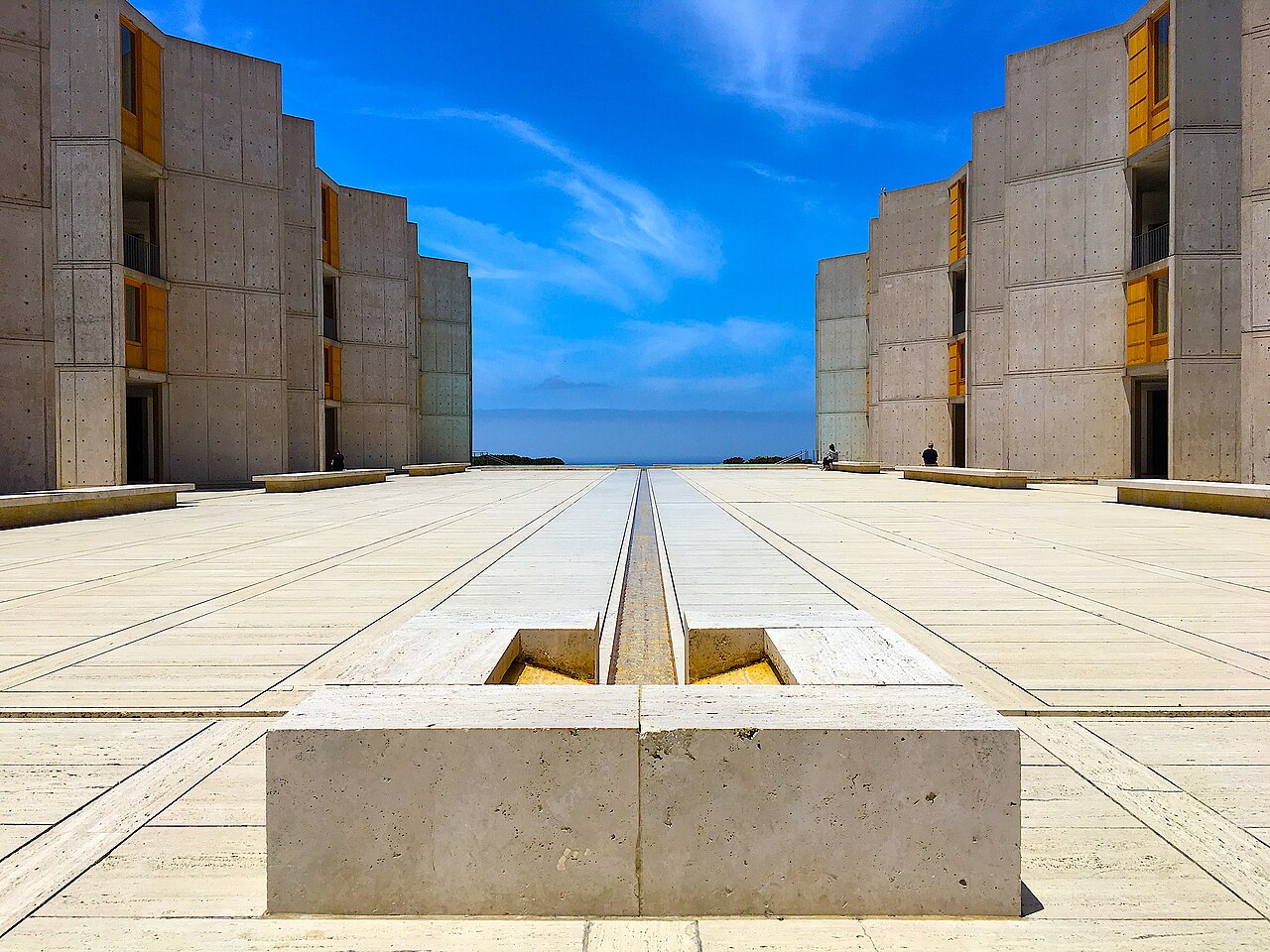
RA: I think I chose Louis Kahn because of how many intersections there were in that experience. It was the context of coming from a suburb 45 miles outside of Los Angeles. I grew up in baloney-coloured stucco houses near a rural area. So there was fake olde architecture from the ’60s, and then Claremont Colleges was nearby, but we didn’t really go there. So to work at the Jonas Salk Institute and suddenly be in residence in La Jolla, California, it was a gateway to not just architecture. It was never really fully fulfilled, what this was going to be, but it was these twin buildings with a symbolic river running between them, overlooking a two-and-a-half-mile nudist beach.
GB: I love that. They don’t mention that in any of the literature.
RA: Black’s Beach is famous. It’s the longest nudist beach probably anywhere in the States, at least. And it’s not near anything, so the kind of wildlife there is also more intense.
GB: Interesting.
RA: And Jonas Salk was still alive then, so it was like walking alongside Einstein or something, with his crazy silver hair and a notepad, not seeing anyone except for the equation on the pad.
GB: That’s amazing. And the whole thing was in service to humanity.
RA: I worked on a few projects. One was looking for care or treatment of diabetes. I found the whole experience of being there transformational. I’d get done with work and trot down to the nudist beach. Once this summer programme I was in made an award for me, the Burnt Buns Award. They glued buns on a placard.
GB: There’s a lot going on with this choice. First, tell me how you ended up there, because you were 16, right?
RA: I was 16 and I excelled in biochemistry in school. And there was a programme called Upward Bound, and they had this science and medical programme in San Diego. I was the only one at the Salk. Some people worked at a local hospital or UC San Diego campus laboratories or the Scripps Institution of Oceanography. So it was kind of a science-nerd programme. We stayed in dormitories at the university and it was over the whole summer. We’d be there five days a week and then go back home at weekends.
GB: Tell me a bit more about the nudist beach.
RA: Well, in the ’70s you still had the flavour of the ’60s, right? So there’d be a nude body-painting pageant, nude volleyball. You went down a goat trail to get to it, so essentially there were no families, because it was so hard. A lot of places like that are hard to get to – you have to work for it. So you go down this precarious trail and then the volleyball game was there. To the left was kind of more hetero and to the right more homo, but not necessarily the strictest line. And then they would have parades through there of everyone naked, nude jogging, which didn’t really seem to work for anatomy, but people did it anyway. And then a population of US Marines coming straight from Hawaii – you could spot them because they were super tan, wearing puka shells, with the high-and-tight Marine cut. So that, and the hippie element, and then just sexual-freedom-movement sort of people. It was really at its peak, I think, when I discovered it.
GB: Could you have predicted that the world would end up in its current state?
RA: I come from tough times. I wasn’t raised by my parents. I come from a tough family, a tough religion. And to leave it at the time of drug addiction, AIDS. Apocalypse culture is kind of my lane, but it still feels worse than that. I think in some of my ’90s work I formulated this idea that healing is the trickster. It’s not a restoration. And it’s the same thing with progress. Progress often comes with mediocrity. And can we fight progress just to stay edgy? I think of people like Jean Genet; he wouldn’t support LGBT rights because he knew it’d become mundane, like people getting married and adopting babies instead of staying revolutionary.
GB: You’ve chosen a building by Louis Khan, who was so influenced by classical ruins, the kind of austere things that were left behind. But all of that originally came from a certain amount of decadence. So there are these cycles: decadence always feels like it’s temporary, because it’s living like there’s no tomorrow, and then there are these grand remains left behind. I sense that a lot in your work.
RA: Yes, I wanted to talk about the elements. They told me it was built from concrete, and then what was visible was iron rods that would purposely rust, so there’s dripping rust. And then everything’s capped with teak wood, which is a more fragile wood, so it instantly looks kind of like bone, bone wanting to be still cleaned. The rust and the instantly weathered wood on top of the eternal concrete. And then it’s kind of surrounded by some angular plantings of citrus trees, bits of citrus grove. All of Southern California has at various times been covered in citrus, so to add a little bit of that history was also interesting. I always appreciate a sliver of nature. I bicycle on the LA River bike path every day, and the part I ride on is the only soft-belly part of a concrete river, with snowy egrets and new sycamores growing; it’s this delusional, tiny, long, long strip of nature. So we have our slivers in our respective cities where nature still comes back.
GB: Talk to me about beauty in your work, because when you created pieces in the ’90s like St Sebastian, with the needles and bloodletting, were you rejecting beauty, or looking for a new kind of beauty? Was beauty a part of it at all?
RA: Beauty was the negotiation. I’ve always described myself as having an inner cheerleader, but I’m also dark, and I have some guilt around how dark I am. When I saw a man that weighs 80 pounds dying in the arms of a caretaker, I saw the Pietà, I saw St Irene resurrecting St Sebastian. I went through the archetypes of that work, and our legacy of those archetypes is religious paintings that are amber and sepia, with auras painted. So I started trying to recreate those in tableaux. Performance art is such a big field, and a lot of people do – I call it action work – where it’s just a white cube, a bag with props and their day clothes on, but beauty was always key to me. I always felt like I had a right to create and define beauty myself. Beauty doesn’t have rules. So I could see the horrific – and those paintings are the best example – things like the gangrenous Christ. They just go really far. They push, push, push. And then another obsession is the cephalophores, the headless saints of Saint Denis of Paris. These paintings have an aura where the head was, and then the head also has a halo, on the ground, three steps in front of them. Everyone’s in lush robes on a greasy street. The shine, or the beginning of decomposition, in bodies in paintings.
GB: I love the expansiveness of your work – you’re happy to take on an enormous former cathedral and bring all these elements in.
RA: Yes. A lot of the settings have been dreams. St Vibiana’s Cathedral in LA was the first Catholic church ever, until recently, when they built a big one. But it’s on Skid Row. It’s in the worst part of LA. I used to walk by it in 1980 and think, this is the only place in LA that the Pope can sleep – behind that gardened wall, in this building from, whatever, 1840, which is ancient in LA. We don’t have Westminster Abbeys. We go back to mud buildings. I was perplexed by that. And then much later I saw a performance by Diamanda Galás in that space. Once it was deconsecrated, it became a posh Catholic wedding factory. But Diamanda did a thing there, and it was amazing, because she held up the concert and then suddenly a hospital bed was wheeled in, and they brought her mother to the front row and hydraulically sat her up. And then maybe a year or two later, through the Broad Museum and the Mike Kelley Foundation, I was making this automatism opera there. So that was the dream. The other dream was Biosphere 2. Going back to science -Biosphere 2 was built on a mountain in Arizona, in Oracle, Arizona, where people went to live in a closed environment and make their own oxygen and food for a few years, and it failed. And so we were doing something through MOCA Tucson, and I thought, can we get the Biosphere? And someone on the board of directors there, Dr Jane Poynter, a British woman scientist who was a Biospherian, got it approved in two weeks.
GB: Do you think out of the times we’re in, we’re going to get great creativity, or even amazing hedonism?
RA: I hope so. It’s just we can’t compare it to the Reagan–Thatcher time, because of technology. Almost a bigger fight is social media and AI, more than the actual reality of the world dying. What’s the point of making something glossy that could be glossier with AI?
GB: And the actual patience to go through the creative process – does anyone even have that?
RA: I think the answer is yes, there will be a burst of creativity, because we’re alive and we need each other. I think things have to be realer and stinkier and more present and more alive than ever. We have to stop being so popularity-centric. Something is more important if only 60 people are there. Your friend group of six is better than knowing everyone a tiny bit all over the place. So I think quality has to be the answer. That’s what I want, anyway. And again, going back to the archetypes – I guess that comes from having been religious; people call it the God hole – I want a sublime experience. I want a miracle. A book I quote a lot is Pictures and Tears [by James Elkins]. There’s a chapter on St Catherine of Siena, who got stigmata by looking at the unveiling of a painting of Jesus with the crown of thorns. And she later became paralysed, cataleptic, from looking at a Giotto fresco of Christ buckling under the weight of the cross. And she died a few weeks later, stiff as a board the whole time.
GB: I’m interested in the fact that you sent a link to the Louis Vuitton fashion show that took place in the Salk Institute.
RA: Well, I love fashion. It’s like a love-hate thing sometimes. It’s so classist and delusional and slurps up every idea around it. But it actually really shows off the compound, especially in lieu of it being closed down after 9/11 for security threats. Every time I went down there, I would walk someone through and go, “I used to work here. Here’s the cafeteria,” blah, blah, blah. And then there was this devastating view of the ocean at the end of the symbolic river that split the two. So it opened up for a fashion show and they packed it and showed an enormous collection and it was so dramatic.
GB: You’ve chosen something so huge, with all of these elements. I think that suggests you have this huge appetite for life,
RA: That’s why I chose to have a destination 65th party in Athens, Greece, where my collaborator Hermes lives. I go there every year, at least once, and I’m spending all of December there. My birthday’s the 16th. My horoscope hobby – I’m a Sagittarius in four houses, which is called a stellium, so other Sadges are joining me there. Speaking of decadence and crumbling and decomposition, I love Greece. I have a love affair with that country.
GB: Your new show is partly based on actual fieldwork there.
RA: Yeah. There is still such energy in the site at Delphi, and Epidaurus has an amphitheatre where they have a theatre festival. The Asklepieion ruins are down to the ground and the same with Eleusis, where the Eleusinian Mysteries happened but those things were still so thrilling to see, I went to them all twice.
GB: Do you think we’ll feel some of that energy in the new show?
RA: I think so. I also got my palm tattooed with the Rod of Asclepius.
GB: How much did that hurt?
RA: Every inch was a different flavour of hell. There was tickly hurt and burning hurt. Our hands and the bottoms of our feet are bizarre, a different nature of skin from the rest of us. Anyway, I care about these talismans. I feel like that’s an investment in the research. I do bodywork that’s like Rolfing. And then I think, with all the issues in my head and life, I relate to the archetype of the wounded healer. So I thought I’m not going to make a piece about Chiron, the original wounded healer, but his student, Asclepius. I care about healing and therapy and investing in holistic communities, just to stay in that lane.
GB: You must know a bit about Louis Kahn and the fact that he was scarred from an accident he had when he was three. Do you think that also helped him create this beautiful work?
RA: I absolutely think so, because that changes the way you see yourself and then the way the world looks at you; those imprints on you. I think he had a scarred beauty that I can relate to, because the disfigured are treated poorly, and probably more so in that era, when he was a child growing up.
GB: And do you think he has some of that same energy you’re bringing from ancient Greece?
RA: I think so. And he’s from old Europe, Eastern European. Those things just keep resonating. They’re the beginning of so much. And they’re not nailed down, so you can keep applying new ideas over the top. And what is a mystery object? What is creation space? Even on the smallest, weirdest islands you find an old amphitheatre, even if it only ever held 300 people. Some of them are in decent shape just because of the nature of their shape. I need a residency in one. That’s my next space.
GB: There’s a question I ask everyone: what makes something worthy of the word beauty to you?
RA: I think I have to go into the category of undeniable beauty. I’ve read two essays from the ’30s on the pineal gland; one by Georges Bataille and the other by Manly Palmer Hall. And so this idea that something really beautiful, we’re not seeing with our eyes, we’re feeling it. Of course there are taste rules about beauty, but that’s why undeniable beauty, even if it can be corny, old, new, something that’s in my “no, I don’t like this” category – the thing is the thing.
GB: That’s interesting. So you think there are things that are beautiful that you don’t actually…
RA: That I don’t like.
GB: You don’t like them. Wow.
RA: Yes, all the time. And lots of fashion sits in that for me. In general, I’m kind of tired of paintings and never want to look at them, and then I could still be crying in front of a painting, or gasping. I’m not a minimalist. And then I was flipped out at the Ana Mendieta thing – the whole context and the passion in the work, and how minimal it got, just a vulvic ridge of mud. But it’s so true to the entire body of work that you just can’t dismiss it for being minimal or being sacred-nature-girl work. It’s really hitting something emotional.
GB: And is there something spiritual in beauty for you?
RA: I think there can be energy in it, but I think it can also just be perfection. And I’m a more-is-more person too. So anything excessive.
ASCLEPEION by Ron Athey with Hermes Pittakos, Carmina Escobar, Federica Dauri and Myrgon is part of CEREMONY, Future Ritual’s festival of performance art, in Peckham from 25 to 29 November 2026, at Copeland Park, SE15. It plays on Friday 27 November and on Saturday 28 November.


Leave a Reply