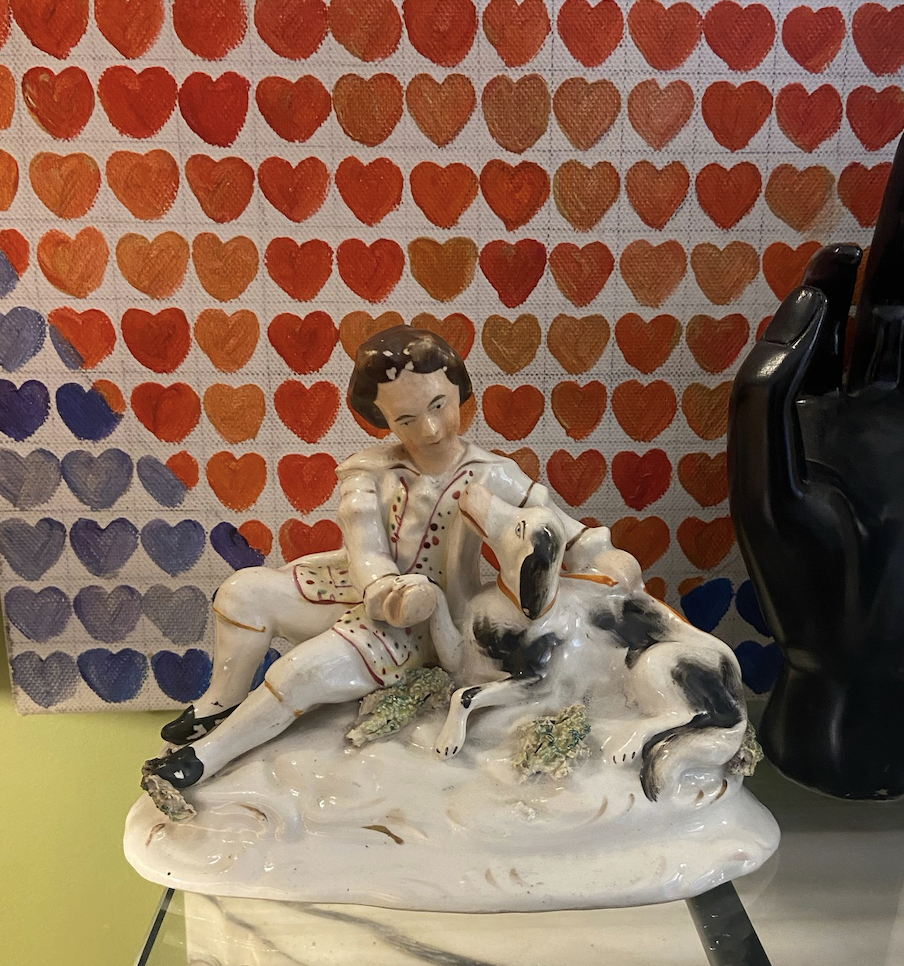
Peter York — journalist, author, market researcher and cultural commentator, on a Staffordshire figurine of a boy and his dog.
GB: Tell me why you chose this figurine.
PY: In my case, I’m afraid it’s a surge of sentiment. I do think it’s a very pretty, completely archaic, hugely sentimental object, conceived as a sentimental object for a sentimental nation. But it gets to me, and I think it’s genuinely pretty in its own right. There’s a huge pudding basin of sentiment involved. I won’t pretend otherwise.
GB: Tell me what this is.
PY: Here it is – I have it right here. It’s a Staffordshire figurine of a boy and a dog. I believe it was made between 1840 and 1850, though interestingly the boy’s clothing is really more like 1770. It’s very much more an eighteenth-century conception than a Victorian one. As Staffordshire goes, it’s pretty good. I have other Staffordshire pieces I like for their subject matter, but they don’t do it for me sentimentally the way this one does. This is the one. It’s very dog-loving, very sweet, very nicely composed.
GB: Can I see it? Oh, how lovely. The dog’s face is beautifully painted – the first thing I always look at in a figurine is the face. And this is so gorgeous.
PY: The dog’s face and the boy’s face, looking at each other, and the dog’s paw resting in the child’s hand: it’s very, very nicely composed. It’s obviously a mid-Victorian heart-puller. But it’s personally sentimental for me because I can’t remember a time when it wasn’t there. It was my dad’s, and he didn’t wait for his mother to die, he brought it around, he must have had it packed in padding to protect it. My mother agreed that this was a very good thing to bring to a marriage because it was so pretty. Everyone agreed. It was always there. It’s a hundred years since I had a dog of my own but this does it for me in every aesthetic and dog-loving and dad-loving sentimental way.
GB: Does the boy have a little backstory in your mind? Is it a hunting dog?
PY: I don’t think it’s a working dog, and he doesn’t look like a shepherd, he’s rather dandyish, actually. Very nicely dressed. Not only is he wearing eighteenth-century-clothes, it’s a much more eighteenth-century composition.
GB: I was wondering how you dated him because of this.
PY: I once asked somebody who told me once that it was made in the mid-nineteenth century but was deliberately retro in design and clothing. A lot of Staffordshire referenced celebrities or stories from the newspapers but this is pastoral. I think it’s dead lovely.
GB: Is part of the appeal of Staffordshire that it was a democratisation of very fancy Meissen and porcelain from the eighteenth century?
PY: Absolutely. Staffordshire is very much a thing of the people. And I think that’s something I didn’t consciously consider when I was small, but thinking about it now, that’s what makes it so interesting. A lot of the female painters in the Stoke factories never went to art school; they came up through the ranks and became brilliant designers and organisers of painters. It was an opportunity area for women long before there were many such opportunities. When you watch the Antiques Roadshow, the experts zero in on who’s likely to have painted a particular piece – each factory, each cohort. I think that’s rather remarkable.
GB; I love all of that. I think a lot of the pieces in the Staffordshire factories were painted by inexperienced women and children, but your boy’s face looks like it had the attention of someone more expert.
PY: Yes, I think so. And what you’re saying about democratisation is right. Lusterware is exactly the same story; silver and gold glazes as precious metals for ordinary people. I’ve got some Victorian lusterware, and some of the bright gold Worcester too. I realise now it was a great craze amongst art school people of a certain generation who enjoyed it rather ironically. And at the same time it represented very sincere feelings for the people who originally made and bought it. People who’d never had an ironic idea in their lives. They didn’t know what kitsch was. But there’s no irony for me with the figurine. My heart is completely pure about that adorable thing.
GB: Do you think something can be both kitsch and beautiful?
PY: Oh God, yes. Over there I’ve got something which is completely kitsch — a seventeenth-century looking bust, probably meant to be Charles I. But it was made for a film set. It’s pure resin. It looks pretty good to me, so I put it up. I like quite a lot of things that overlap between the sincere and the ironic. These Wedgwood black basalt urns I have, were a re-edition from the nineties when I worked for the company under Sir Tony O’Reilly – I’d already absorbed those shapes, those urns, through a school friend whose father wrote the definitive book on Josiah Wedgwood’s designs. So I was primed to love them. And when they gave me three of a limited re-edition of one hundred, I was delighted.
GB: If you could own any work of art in the entire world, what would it be?
PY: I would want something by Andy Warhol. I met Andy on my first trip to New York and he was wonderfully different in person from his public persona – much more talkative, much more tactile. A great friend of mine, now dead, had Andy paint her dog. She was very close to him. That’s a very wonderful thing, isn’t it? I’d like to have had me, done by Andy. In the meantime, I had a rather large picture of myself by a friend who’d just come out of the Royal College of Art – nearly full length, standing in the window of my then flat. He did it very well. I’m entirely in favour of it.
GB: And what about nature – mountains, seascapes? Is that a higher form of beauty to you?
PY: I’m pleased when I see a nice bit of it. But practically speaking, I never go to foreign countries and I’m completely a product of the city. I mean, if you’re going to stay with someone in the country and there’s a train and someone meets you and takes you down little green lanes – that’s very soothing. But I wouldn’t want a whole week of it.
GB: Give this figurine marks out of ten for objective beauty and marks for sentimental attraction:
PY: I do think the figurine has a great composition. It probably derives from a well-known painting or popular print of the day – rather earlier than it was made. I think it’s very well conceived and very well executed. It’s sentimental in a rather marvellous way. The sentiment is done brilliantly. I’ve got things which in strict aesthetic terms are grander and more fashionable, but this has a unique quality. As I say, it’s on the chimney piece with rather different objects: the Mack truck dog, which is very American and very deco, and the bronze ram’s head in between. They are culturally completely different things, sitting side by side. And it still wins. It has nothing but happy memories attached to it. And I can see why, over a long period, my father must have thought of it as a reminder of something precious.
GB: What makes something worthy of the word beauty to you?
PY: There are lots of different cues, and the response can be very different for different objects. I’m afraid that having known a lot of people who think about things in a kitsch or ironic way, people who’ve been to art school, people who’ve written about the attractiveness of objects; it’s all filtered into me somehow. It’s harder to get back to one’s original, unfiltered response to something. That first impact you have as a child, before any framework has been placed around it. That’s the remarkable thing about the figurine. It came before I had any vocabulary for it. No irony, no art school conditioning. Just: this is lovely.
 GILDED BIRDS
Leave a comment