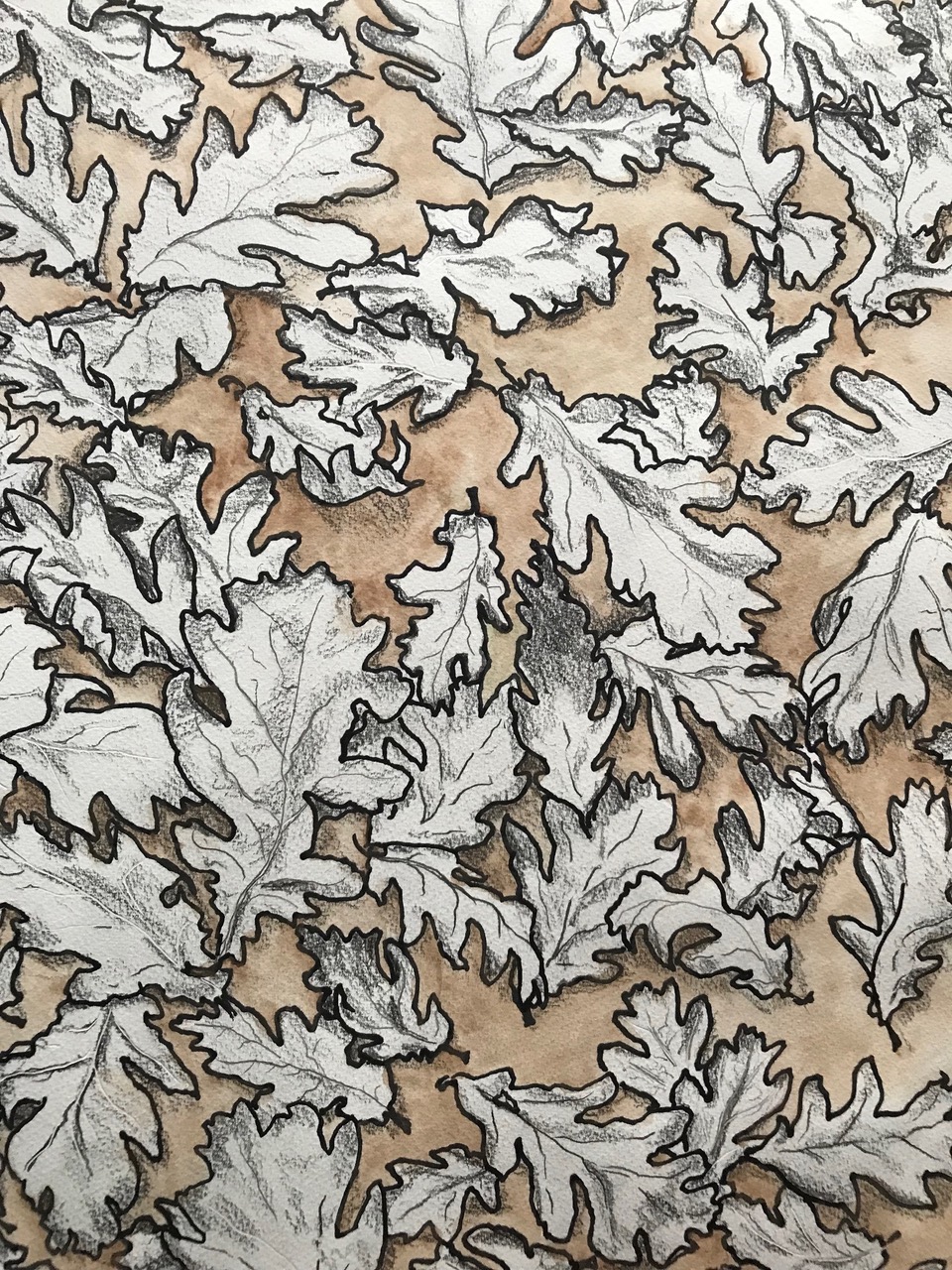
Robin Shaw, artist and author, on oak leaves.
GB Tell me why you’ve chosen oak leaves as your object of beauty.
RS Well, I’ve always liked trees and I like drawing trees. What I’m doing at the moment is, we have an oak tree in our garden, and I’m doing a picture every fortnight from the oak tree and showing how the oak tree comes out across the seasons and changes colours and erupts in its buds. In the autumn, I just drew the litter of the oak leaves on the ground. They’re lovely shaped oak leaves. I suppose everybody thinks so, obviously the National Trust does, but I’ve made pictures of them with all their variety on the floor.
GB And you like them better than an American oak?
RS Oh, I don’t want to discriminate between them, but they’re English and I like our English ones.
GB So tell me how you develop this style of drawing, because it’s quite unique with your mix of Sharpie and watercolour and pencil.
RS I’ve only found it in the last 10 years or so. I’ve always drawn with pencil and pens, but suddenly I found the Sharpie pen and it makes a very thick, black, dramatic line. And I find this very satisfying. Somehow the hand moves better for me with a thick dark line than with sketchy little ones. I sit down with a Sharpie pen and a blank sheet of paper and I start drawing a leaf or a flower or something. I seem to get the shape and the impression down much better than I would normally with a light pencil. It’s unforgiving because it’s a thick black line and there’s no rubbing out or altering it. It has to be right the first time and I find that I draw better that way somehow. I don’t always succeed, but some of the drawing comes out just as I want it to, as though the composition makes itself – almost as though the pen is actually animate and doing it for me.
GB Is that partly because you’ve been drawing for years and years and you’ve got the confidence to go in there with a Sharpie?
RS No, I don’t think so. It’s something to do with the dark, indelible nature. But I did have a stage at one time when I drew with a very soft pencil and I found that very satisfying with a thick black mark that was before the Sharpie. And of course a Sharpie has got its disadvantages, the line more or less the same thickness. And if you look at the drawings of the masters or the Japanese woodcuts and so on, they use thick and thin lines to very great effect. But the Sharpie limits you to one thick line. There’s something about being limited by your medium, which makes you adapt to it and it brings out the best in you.
GB So when we’re at school and we first learn to draw, we draw everything from outlines and then we progress a little bit. We’re told not to do an outline, but actually our natural tendency is to see things in terms of outlines, isn’t it?
RS Well, this brings in a whole area of interest in art – that children draw mostly from imagination. If you ask very small children to draw a man they draw a round circle and put some spiky legs on and some spiky arms with a single line. And of course it doesn’t look like a man at all. It looks the way they imagine a man. At a stage in evolution people developed the thought that they ought to draw from the actual object in front of them. And then you get clearer animate outlines. The Egyptians did very stylized drawings of people in profile. And you can relate that to the child drawing the circle with spikes on it. But later on you get the Greeks and the Greeks show what humanity really looks like. Their figures and their sculptures are really trying to absolutely reproduce the outlines and the muscle shapes of real people. So there are two styles of drawing – what’s in the imagination and what’s in front of you.
But you asked about outlines. I think there’s something very much in our brains and our visual equipment that causes us to draw in outlines.
I will go back a step. Man has always wanted to project things onto a flat sheet or a flat wall or the pre-history man on the wall of a cave. And incidentally, the things that they did on the wall of the cave are what I call realistic rather than imagination. They draw a bison, so that it looks like a bison as we see it, and they don’t do a stylized version. And that’s incredible. They had to memorise what it was like and go back into the cave to paint it.
We have binocular vision and we look at things with our two eyes. You can imagine the primitive man, the hunter gatherer who was going out hunting and being hunted: he needed to pick out from the environment what are either his prey or his predators. So we’ve evolved to look at the environment and look for objects in the environment. And the way we pick them out by seeing outlines. The eye is picking out lines, even though you don’t realise it. Of course nature isn’t surrounded with black lines, but it is surrounded as we see it, with perimeters. I think that’s what leads to line drawing because the nearest thing you can get to reproducing that is drawing a line.There are two ways of showing three dimensional things on a blank surface. You can show it in patches of colour and you can pick up the shape from where each colour meets. It’s a stylized version because you can’t reproduce three dimensional surfaces on a two dimensional flat surface.
GB A lot of the time when I look at old master paintings, I see the beautifully painted finished version and then I see the sketches and for some reason the sketches always seem to bring things to life to me in a way the painting doesn’t. And do you think that’s because it’s closer to the way our brain perceives things?
RS Yes, you’re right. Well, I do what I call direct drawing. That means I only draw from an object in front of me. I don’t look for a photograph because a photograph doesn’t show that three dimensionality. It doesn’t show the edges as we see them. And I haven’t got the imagination to draw completely from memory. If you draw directly with a flower in front of you, that’s the nearest you can get to reality. It’s not translated by photograph back to human being. It seems to me that logically that’s the nearest way you can get the truest drawing of something.
GB Do you think the old masters were cheating a bit when they used camera obscura for the perspective?
RS I don’t think they were cheating because you use all sorts of devices to try and improve your work. And I suppose perspective might have taken a lot longer to develop if they hadn’t come up with those techniques.
GB If you could have any artist you like, alive or dead, draw you some oak leaves, who would you choose?
RS Oh, I don’t know. I mean for drawing accurately and what is there, you have Durer and Michelangelo, Leonardo DaVinci, and they made superb detailed drawings. I’m dabbling in an area somewhere between accurate detailed drawings of things as they really are and between design as well. I’m hovering in this hinterland. A designer like William Morris, isn’t trying to do really realistic leaves. They’re stylized and they’re wonderful. I’m operating in the middle somewhere
Gainsborough wanted to be a landscape artist, but in his paintings of people, he puts in the background trees with great big floppy leaves, which are really nothing like realistic trees. It’s because he had the people standing in front of him posing for the portrait and then added the trees from imagination. Oliver Rackham, who was the great guru of forestry and trees, wrote that very few artists can draw trees realistically, you look through the old masters and you can’t identify the trees from the pictures. A tree as big as an oak tree has got 200,000 leaves on it. You can’t draw 200,000 leaves. You’ve got to find a way of representing that – so if you look at a lot of the mediaeval paintings they paint great big leaves. And another way of doing it is just showing a sort of bushy effect and not picking out the leaves. But a tree is much too complicated for anybody to draw completely.
GB And yet design is often looked at as inferior to fine art.
RS If you take art in Britain around the first half of the 20th century, when artists were discovering Impressionism and so on, all the focus became on the emotional content of a drawing and detailed craftsmanship was despised from then on. For instance all that huge cultural progress of designing Arabic patterns like those on the Taj Maal was dismissed. That’s just pattern. Not art. I don’t think there’s a real truth in that. I think it’s just cultural. Some cultures like design, some cultures like realism.The early 20th century Europeans were very arrogant in saying art is only something which is expressing emotion and rejecting technique and craftsmanship.
My father was brought up to be an expert in design and ornament. He was born in 1882 so he designed in the wake of William Morris and he studied design and ornament of all the races and civilizations. He was quite an expert in it all and he produced illuminated addresses. And then by the 1920s all his work was considered totally inconsequential. The art schools weren’t teaching drawing even, let alone design. Design was written off as a second-rate art form.
GB What makes something worthy of the word beauty to you?
RS This seems contradictory to what I’ve just been saying. It is something which causes some sort of emotional response in you, but I think a design can do that too. In an Arabian Mosque you walk into one room and it can change your mood completely because of the patterning and the skill.
 GILDED BIRDS
Leave a comment