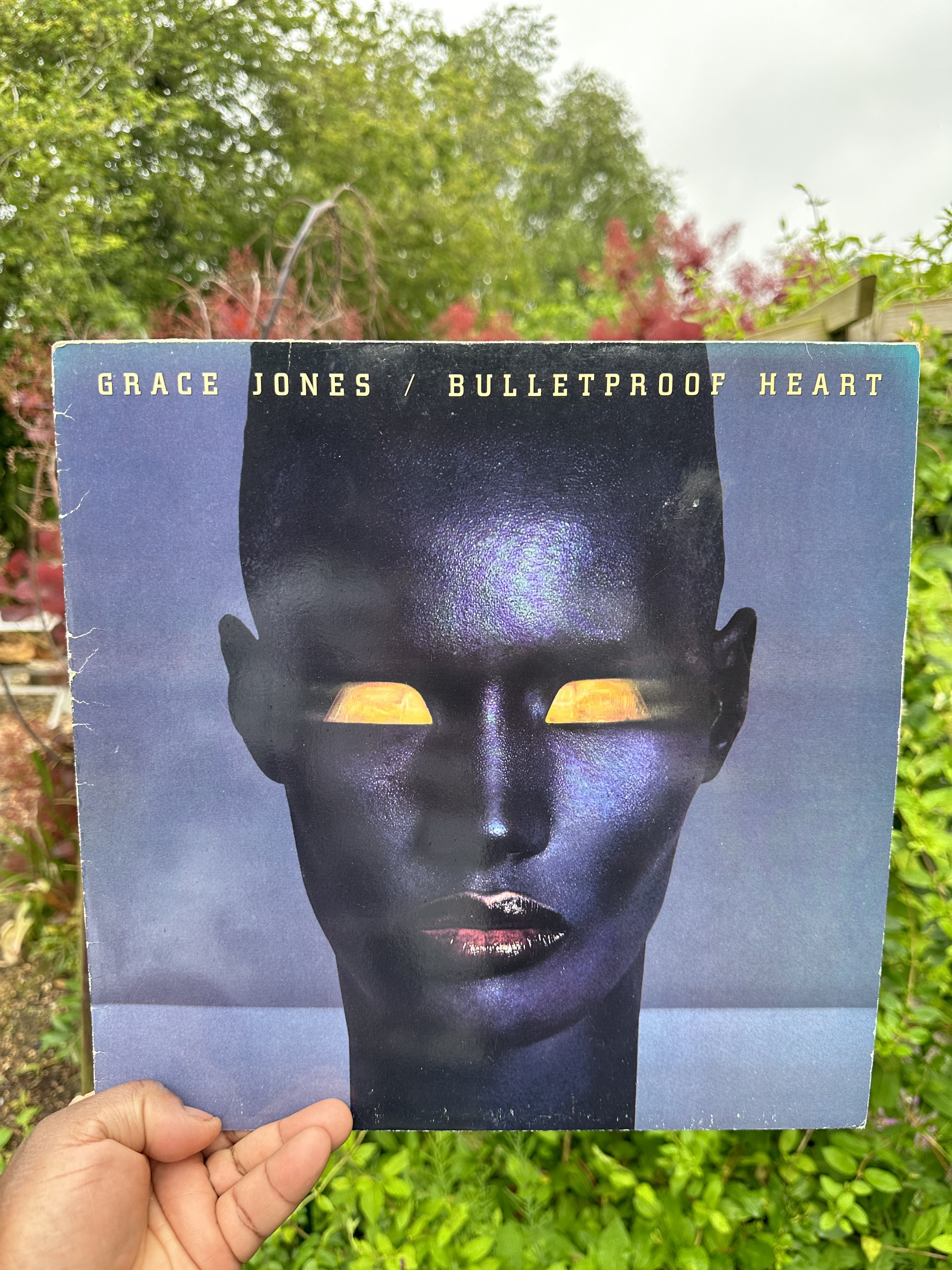
Harold Offeh, artist, on a Grace Jones album sleeve
GB Tell me why you chose this.
HO There’s a long preface in that I’m very indecisive anyway, but maybe because of the art training I’ve had, the idea of a beautiful object is something I got really stuck in. But I’ve worked with images of Grace Jones for a long time and I’ve done a number of performances and projects that are exploring her iconography through her album cover artworks, and part of the PhD I wrote was encompassing that. This is one image of many that I really love. It’s emblematic of a kind of playfulness that she had with her identity, particularly in the ‘80s. I’m interested in the form of the album cover in terms of how one illustrates and communicates music and identity, so there’s a synthesis of that in this album cover. It has to serve a sense of the music but it also has to project an identity and in that space we often find really interesting narratives and cultural trends.
GB I’m surprised you chose this one and not Island Life?
HO I’ve worked with Island Life and obviously I love it to death. It’s one of my all time favourite images. A lot of work I’ve done has been looking at the posing and the way that image speaks to sculpture and dance. But this image comes out of her tempestuous relationship with Jean Paul Goude, the French photographer and art director. I think they were lovers for many years and had a son together. I’ve read her biography and they had quite a dramatic, violent relationship. This particular image comes from that collaboration and Bulletproof Heart isn’t an album that’s particularly celebrated as part of Grace’s oeuvre. It was the last album she made before a very long break at the end of the ‘80s. It’s classic image-making so you get the androgyny but also a sort of cyborg thing which is a trope they’d used before. There’s something about the deep purple colour of the skin that reminds me of Trechikoff paintings like the Green Lady. Jean Paul Goude made a car advert with Grace’s image as a kind of robot head that vomits out this car. There’s this human/non-human androgynous coolness to it.
GB Do you think beauty was part of the intention when they created the image?
HO I think so. I think it’s an elegant, refined, machine-tech beauty. I love the way that it’s just about this floating head with everything else below it like an exquisite corpse, and the way it’s so stripped-back and playing with the LP format. I have this album displayed on my shelves. It’s so minimal and still iconoclastic. She has such an angular head that’s accentuated by the haircut. Grace is a cultural figure who really challenges beauty standards. There’s an edge to Grace. There was that infamous Russell Harty interview so she’s seen as this dangerous black female and that’s something she cultivates and plays with, taking this racial and misogynistic trope and putting it back out there. Her beauty encompasses so much. Annie Lennox was another feminist icon of the same era who had that androgyny and power.
GB Yes, Grace was very serious about this stuff. She worked with big artists and it meant much more to her than just pop.
HO Everything about Grace is a total work of art. She grew up in Syracuse in upstate New York where her father had a church. I’ve even been to the church. She studied theatre at Syracuse before moving to New York to start her modelling career. She was always so aware of staging and presentation and how she sat within a visual universe, which really came through with the collaborators that she brought within her orbit. People describe her as a muse but it was the other way round – she chose them.
GB Yes it’s very powerful the way she managed to work with all these men like Trevor Horn and Andy Warhol without looking like she was a product of them. Her integrity always wins through. Is this point in 1989 meaningful for you in terms of her history?
HO It’s the last in the run of a few albums. There was almost a twenty year gap before she made another album. Things like having a child entered the equation, but she also had difficult relationships with record companies and refused to be packaged. For her it is art and I think she didn’t want to create anything that was going to be compromised. She was never really chasing popular appeal or chart positions.
GB Is beauty a conscious part of your own work?
HO I think I’m partly fighting against my own art school experience. I went to art school in the mid ‘90s when post-structuralism was king and there was a lot of scepticism about beauty. Things had to be dialectic or grounded in critical theory so aesthetics were secondary to these intellectual foundations. So, it’s taken me a while to reconcile my own aesthetic sensibilities. Now I have quite a clear idea of what I’m drawn to and a vocabulary for beauty but it can still be a bit schizophrenic. Modernism has been so much about a minimal rational restraint and I like a messiness and layering. I like bold colour and work in quite bold forms to create a spectacle. For me, that’s often associated with how to seduce people or bring them into a work, in the way that aesthetics can allow people to enter a space that may be more complex. Beauty has become a difficult conversation but I like the way beauty is visceral. I like the way that it can be overwhelming and that the sublime can be an apotheosis of the experience of beauty. People often can’t get past taste when it comes to art and taste is irrelevant to me.
GB Do you think this album cover is beautiful to most people?
HO I don’t know. I hope so. Grace Jones has a very culturally literate sensibility so certain people will be really drawn to the sophistication of how this image is put together. Outside of that, I don’t know. That’s the challenge of Grace. Right now, the biggest female-identifying posters are very sexy and feminine. Grace was never hyper-femme. I feel that there’s a cultural conservatism right now. I don’t know if she’d be picked up by a record company in the same way.
GB What makes something worthy of the word Beauty to you?
HO I can only speak to that in relation to myself and what makes something worthy is impact and for me that’s driven through a clarity and seduction in image making.

 GILDED BIRDS
Leave a comment