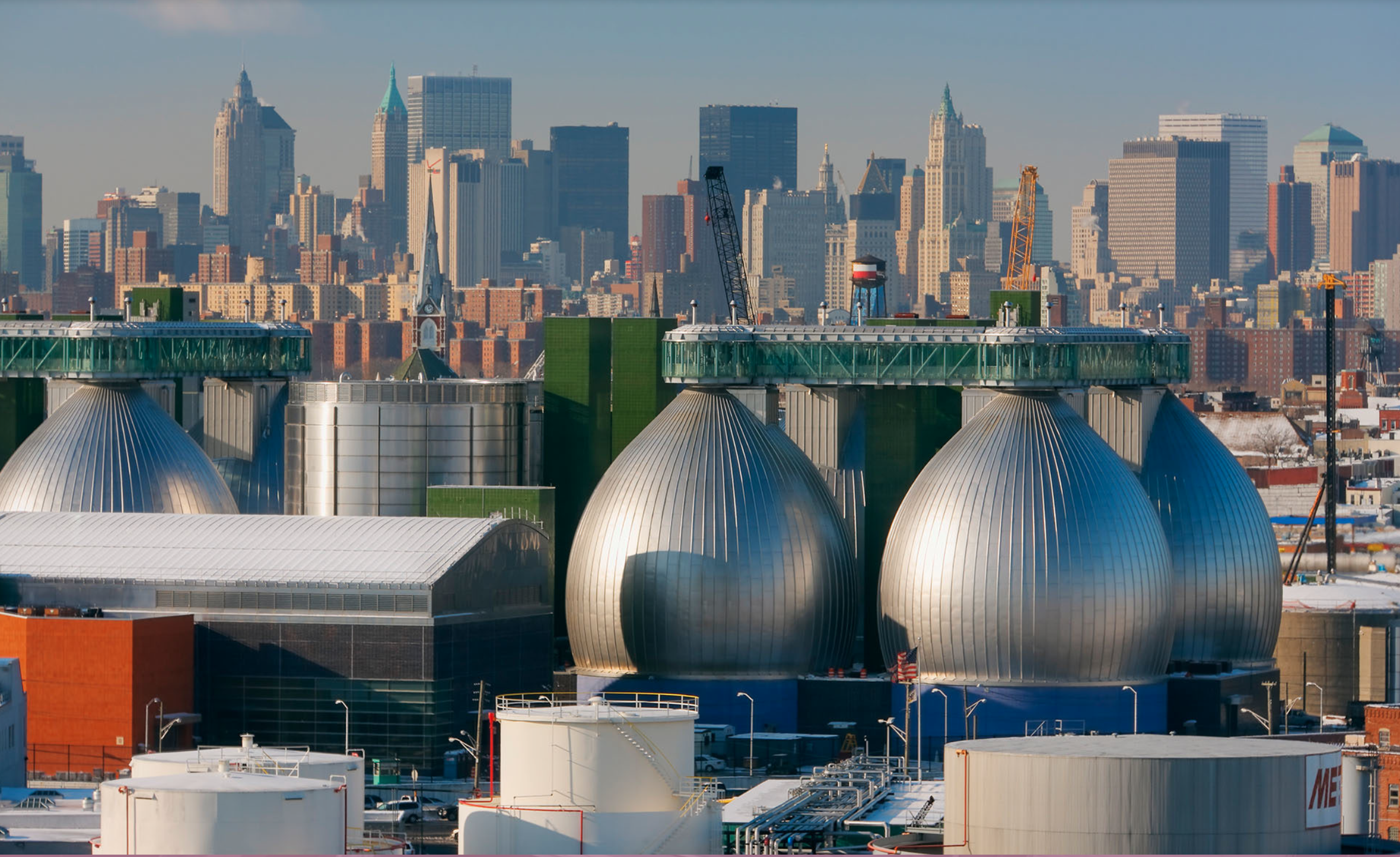
Bianca Bosker, author, on the Newtown Creek Wastewater Plant in New York
GB Tell me why you chose this.
BB These “shit tits” as they’re informally known, are part of a breakthrough in my idea of beauty and my life hasn’t been the same since. The official name is the Newtown Creek Wastewater Treatment Plant and it treats sewage so, as a resident of New York City I’ve probably been unwittingly familiar with it for years, but I think my real relationship with the shit tits started when I was on this multi-year journey that involved me disowning my regular life as a journalist to sell art in galleries, work for artists in their studios, patrol museum rings as a security guard – all this and more as part of this journey into understanding why art matters and how do we engage with it more deeply. I was working for the artist Julie Curtiss when she asked me to do research on the shit tits which she was considering incorporating into her paintings. To Julie, they were beautiful. That caught me off guard in the way that sexy and halitosis are unexpected; you don’t expect to hear the words sewage and beautiful in the same sentence. But I started seeking them out, I couldn’t stop thinking about them, I pitched my editor to let me do a story about sewage, I felt like they had this magnetic pull. I think that beauty is often treated as a dirty word in the art world these days but I came to see it as also essential. I don’t think beauty has to be the visual equivalent of a vanilla cupcake and it doesn’t even have to be something physical, but I think that beauty pulls you close. Beauty is a vote for life, it’s something that draws us deeper into our existence, and to me, I realised that this sewage treatment plant did that. The shit tits pulled me towards them, they caught my eye and made we want to bask in their presence, they made me wonder at the world and my place in it. They helped me realise that in the course of immersing myself in art, I’d come to a much more expansive idea of beauty. I think beauty is that moment where our mind jumps the kerb, and the magic of art is that it can make us see beauty in places that we never did before.
GB Do you think that the first time you looked at the shit tits you were seeing them through the eyes of Julie Curtiss?
BB Yes. What started me on this journey was the desire to develop my ‘eye’. I wanted to see if this journey into art could teach me to not only see art differently, but also the world differently. Julie changed my life in so many ways. She taught me how to look at the everyday with an art mindset. She took inspiration for her paintings from a motorcycle or the lobby she would pass on the sidewalk from the ‘blah’ expanse of Midtown New York. She had this ability to turn an art eye on the everyday, which to me means pondering how not inevitable something is, letting yourself see things by unseeing them. One of my favourite things about going to a museum or gallery these days is stepping back out onto the street and suddenly looking at a hotdog cart the way I did a sculpture. Art ultimately helps us fight the reducing tendencies of our minds. We do not go around the world like video cameras, dispassionately and accurately recording the scenes around us, instead our brains are like trash compactors. We have these filters of expectation that descend and creatively sort, categorise, organise the raw data coming in before we even get the full picture. I think art, as scientists as well as artists have come to see, is powerful because it introduces this glitch, and this glitch is a gift that helps our brains escape those well-worn pathways. Prior to immersing myself into art, the shit tits would fade into the backdrop of generic ugly infrastructure. Julie’s ability to lift that filter of expectation and to make me stop and ponder different parts of the everyday with that extra beat, with that art mindset, transformed my relationship to them and helped me see their beauty.
GB I like the way you describe this in your book as learning to look at the world without identifying what you’re looking at. Do you think you attempted to look at this huge structure in terms of form and colour without thinking about the function?
BB I think it’s a combination. One of the things I learned from art in terms of how to look at things, is to slow down, to pay attention to physical form and to examine the decisions that led to this thing existing in the way it does. I think with art, for the last hundred years or so, we’ve been told that what really matters in art is the thought behind it. The thought trumps the thing. It was startling to me to go and work with artists in their studios and discover just how athletic making art really is. As Julie puts it, an idea is not a painting, painting is constant decision making. As far as the shit tits go, part of their beauty for me relates to their form, but part of it relates to knowing that these sleek, glowing, beautiful orbs exist to process poop. There’s something incredible about that tension. I came to believe that there is an artist in each of us in the sense that we struggle to keep our minds from compressing our experience of the world around us. Art is a fight against complacency. It’s a decision to open yourself up to the chaos and beauty of the world around you. Working as a guard in a museum I heard a lot of hushed murmuring about indexicality, post-post-modernism and liminal space. It was artists who encouraged me to contemplate the actual thing in front of me, which could be a sewage plant or a mouse trap or a painting. I got some advice from an artist to try to notice five things. They don’t have to be grandiose. It could be just that this pink makes me want to lick it. I found that staying in the work helped me experience art on my own terms.
GB It came very naturally to Julie to think like that. I know you’ve spoken to a lot of neuroscientists too. Do you think that some people have brains that are biologically more prone to this type of thinking?
BB The research on art and neuroscience is tough, in part because we struggle so much to define what art is. I like to believe that neurological flexibility is something that we can hone through practice. I want to believe that we can develop our eye, that we can lift our filters of expectation.
GB If I’d asked you to choose an object of beauty before you’d been on this journey, what do you think you’d have chosen?
BB It’s so hard to say, but it would not have been a structure containing millions of gallons of decomposing faeces and dirty bath water. The photos on my phone are probably a good indication. I probably had photos of beautiful bouquets, whereas recently I saw a billboard at the side of the road in Houston that was an advert for sexy teeth. It was a juxtaposition of this fresh, smiling model against an industrial landscape – and the idea of sexy teeth was such a weird concept.
GB Can you define how much of the beauty comes from the visceral appeal compared to the beauty of the memories of working with Julie?
BB Beauty as a concept is a mess. I came to place where I decided that beauty is so hard to define because it’s so personal. It’s a product of who we are, what we’ve seen, what we care about. It doesn’t have to be physical either, but I think beauty is less a measurement than a magnetic force. I think beauty nudges us to a place where we’re wondering about the world and our place in it. These digester eggs are physically arresting and intriguing but I also think that when you see them lit up at night like alien eggs ready to hatch, there’s something beautiful about the way that whoever decided to create them wanted to highlight these unmentionables. It’s that tension that makes them beautiful. It’s also hard to separate my relationship with Julie from my relationship with the digester eggs because they’re a symbol of a moment in life where I felt like I was undergoing a revolution in my relationship with beauty.
GB Do you think the art world has led us all away from beauty?
BB I think we’ve been led to a place where we distrust ourselves as viewers. These connoisseurs become a lot more important if we’re told that we need advanced degrees, years of going to art fairs and the right pair of jeans to commune with a sculpture. I think it’s important to remember that scientists argue that beauty is ingrained in the human experience. It’s interesting that we try to deny it when we know it’s part and parcel of being human. There are aesthetic primitives that even animals can find beautiful. I think that fundamentally it is essential.
GB So, can you sum up what makes something worthy of the word Beauty to you?
BB I go back to the thought that it’s that moment when our mind jumps the kerb, when we’re nudged into a place of wonder and curiosity and pulled to engage with something more deeply. We want to be in beauty’s company. I think I recognised that the digester eggs were beautiful because I just wanted to be close to them and get to know them better. Beauty can be that spark of curiosity that draws us deeper into life and there’s something so life-affirming about being open to beauty. Denying beauty feels like we’re cutting off our curiosity for the odd and striking moments of life. I think beauty is exciting and I want to be a part of whatever group is bringing it back.

 GILDED BIRDS
Leave a comment