
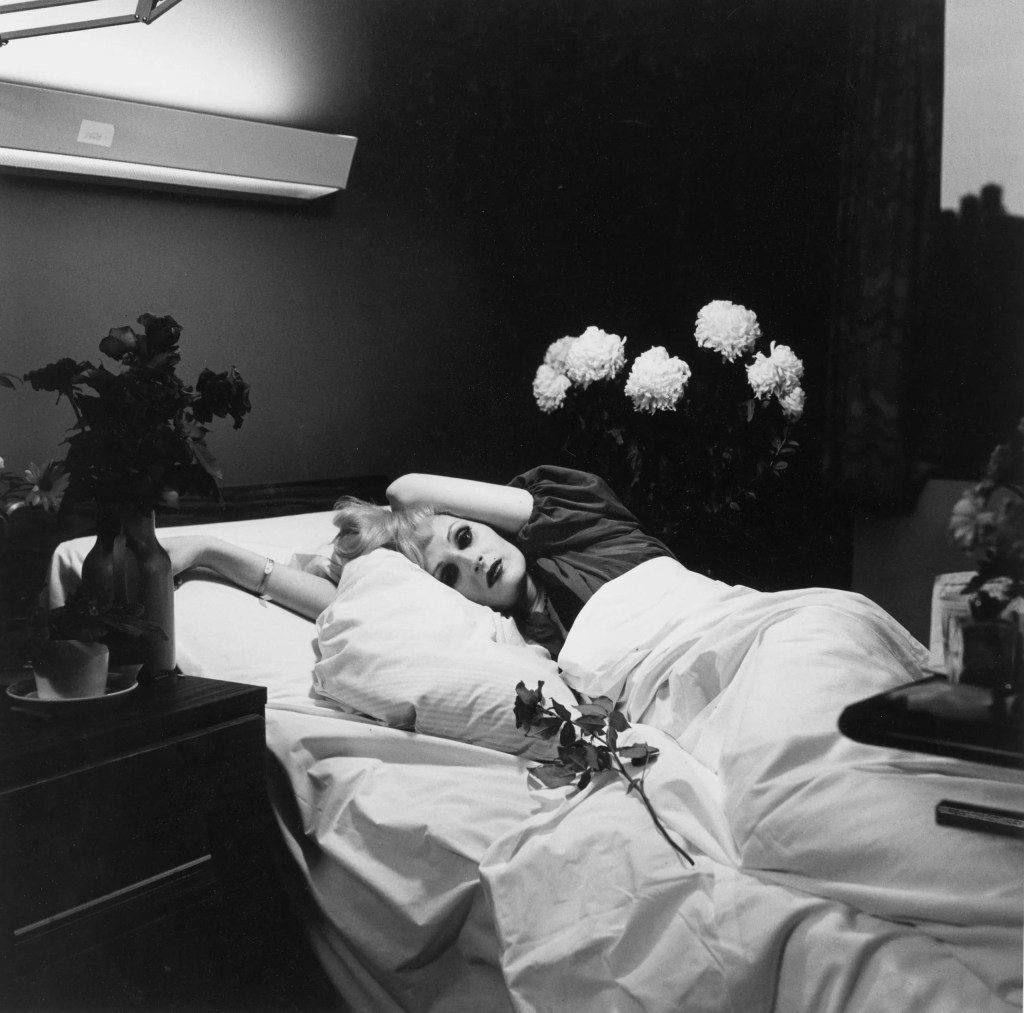
Josephine Jones, model, on Peter Hujar’s photograph, Candy Darling on her Deathbed.
GB Tell me why you chose this picture.
JJ There’s a pretentious part of me that knows it’s a critically acclaimed, seminal, very well-composed image. Formally, it’s sublime. There’s something about being an artist in a world of chaos and being obsessed with really elegant composition, sonically or visually. This is just really satisfying. One can spend an entire lifetime unpacking the themes in this image. In my 27 years I have always responded to this image. I’ve really been touched by death in my life. I’m an orphan. I lost my mum who passed away from breast cancer when I was eight and my dad committed suicide when I was 14. Well, he was in a train accident and we can’t be sure. Candy just looks so beautiful and frail and so herself in this image. I’ve seen few of the other outtakes. Peter Hujar died of AIDS-related illness, rest in peace. This is the most tragic beauty. It’s also iconic in a broader way. People who don’t know her story can still appreciate this image.
I’m coming up to the age she was when she died. She was 29 and she’d achieved so much. She is a star that is still giving so much life in this shoot, she was so excited to do it.
GB Do you think that she really understood that she was dying at this point?
JJ. Yes. She had leukaemia. One still has to be in hopeful denial, that’s how you last a bit longer. I remember when my mum was ill and she’d had a double mastectomy, I knew as much as it was appropriate for a six or seven-year old to know and she was very transparent about her illness. I saw her scar when she was getting changed once and I said, “But you’re not one of those people. You’re going to be fine.” And she just couldn’t say for certain that she would be.
GB It must have been awful just trying to decide how much to tell you.
JJ I saw her fall up the stairs and throw up. She was a primary school teacher and even before she was unwell, we had so many letters from people praising what a brilliant teacher she was. She was a great mum and I trust that she made a measured decision.
GB How was moving to London for you after Buckinghamshire?
JJ When I first moved to London, I was living in Portobello Road in a cockroach-infested apartment that used to be a brothel and a murder had happened there. No one told me what had gone on there until after I left. I’ve been on oestrogen for 10 or 11 years now. But when I first came to London I was very androgynous. There’s something about those early teething years when you haven’t started hormones and you are trans, when I came to understand more and more the intense anger that other people feel. I was owning it. I could never do stealth. I was the first trans woman to show at London fashion week and I didn’t do that to be edgy, I just wanted to show at fashion week. I think about Candy back then and I mean, New York is a tough town now. I can only imagine her resilience. It’s unfathomable how resilient she was as a woman. There were times when I’d get home from someone yelling at me, full of vitriol and anger – and I’d just cry. You learn that the more you engage the more it stays with you. The Hammersmith and City line to Ladbroke Grove is triggering to this day. Even the colour of the seats. I got a lot of strength even from Candy’s second-hand strength. Thinking about how hard it was for her really intensified my admiration for her. I think New York is still more progressive than London because of the Warhol Superstars. I think everyone has a mix of masculine and feminine but Candy was one of those rare people whose soul was just so achingly, archetypically feminine. She was shaped by women from the silver screen. Her story is dipped in tragedy but still holds so much hope. She is a star even on her death bed. Who is bonkers enough to do that?
GB You’d imagine that anyone would find this image beautiful.
JJ Out of context it’s just gorgeous, like a picture of Marilyn in bed. She looks quite ghostly in the other shots. He was a great documenter of the times and this is his most impactful image. I even tried the name Candy on for a week. You try on names like outfits when you’re trying to find your essence. I really don’t want to be a tragic beauty but I’ve had to actively resist the proclivity. I’ve got a very dark side. I’m not vitriolic but I have a morose sense of humour and for those not trauma-informed in some regard it can fall on deaf ears. I’m desensitised to death. I don’t think about it when I see this image. I don’t even want to remember her life in this way but if I was putting it in a time capsule this represents such formal beauty and is from such an iconic documenter of the scene – and if you don’t know anything about her you’ll just think, “Who is this beautiful woman on her death bed?” There’s a quote from Candy saying that above all else to be oneself is the highest form of morality. Candy did the best with what she had and that gives me strength. This is a very sobering image but I want to talk about her success, living long enough to do something this sincere, giving all you’ve got until your dying breath. It reminds me of Matisse when he was almost blind and couldn’t stand up , but still cutting out shapes with his scissors.
GB Do you have a deathbed fantasy of your own?
JJ. No. Just trying not to die right now. I heard a woman on a podcast talking about losing her 42 year-old mother, saying that when you’ve experienced death it’s no longer an alien concept. It’s not so much my life with the chaos of trouble but my life with the chaos of darkness. But I do have all my funeral songs planned out.
GB What are they?
JJ Itchycoo Park by the Small Faces, Candy Says, Nina Simone’s stars – the Montreux Jazz Festival version, maybe something by the Noisettes. But I have no deathbed fantasy because when you’ve experienced death it’s no longer an impossibility. You get nervous knowing you’re coming up to the age when your parents died.
GB What would have happened to Candy if she hadn’t found the Factory and Andy Warhol?
JJ So many people are lost. But I think it was fate that she found them. I’ve coming to believe in God in a way that I’m teasing out like a ratted up wig that I’ll probably never finish teasing. I definitely belief in destiny and the three fates. She fitted right into the Factory even though she wanted to be an old-school MGM girl. She did such a lot with her short life.
GB What makes something worthy of the word beauty to you?
JJ I don’t think there’s a hard and fast rule. It’s a mix of a million different criteria that are inherently personal to the point that it’s so nuanced and so individual and so complex. Before I found God I was looking for God in the next Prada shoe. My parents were profoundly atheist to the point that they wouldn’t even let me have Christian friends. Now beauty is spiritual for me. It’s so poignant. I think I put too much stock in it. But in this image there are spectral echoes of transcestors gone, a personal story, personal history, composition, aspiration, fear, everything.
 GILDED BIRDS
Leave a comment