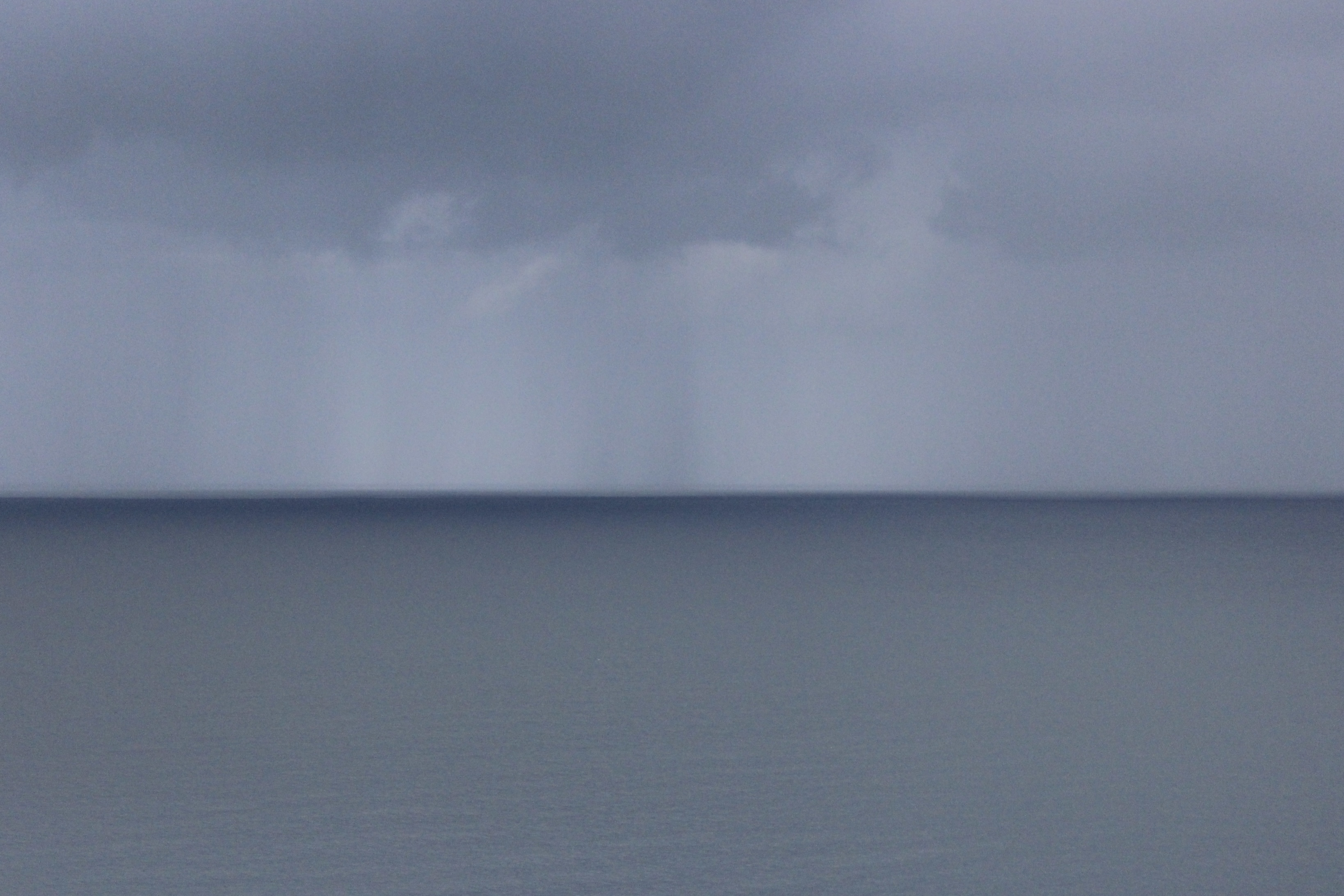
Benjamin Sebastian, artist, on the ocean.
GB. Tell me why you’ve chosen the ocean.
BS. I grew up in Australia by the Great Barrier Reef so I grew up on the ocean really. It was quite a remarkable place to grow up. I was quite torn between choosing a forest or a tree and the ocean as my object of beauty because where I grew up, it’s the meeting of both. We have the Daintree Rainforest that comes down the mountain and meets the ocean and the Daintree Rainforest is actually older than the Amazon.
GB. What an incredible place to grow up!
BS. I try to explain it to some of my British friends and end up speaking about these two animations (Finding Nemo and FernGully) as I find the surreal nature of them useful in attempting a shared understanding. FernGully is a mythical story of fairies living in this beautiful forest around these magical trees and humans come with their bulldozers and try to demolish the fairyland. It’s written about the place where I grew up. It’s right on the ocean and I’ve always had a massive affinity to both water and the sea (as well as the rainforest).
GB. Do you miss it now you’re in London?
BS. Yes, deeply. If not every day, at least every week.
GB. Were you also aware of the danger of the ocean?
BS. One of my most pronounced early memories is of both the horror and beauty of the ocean. We were at my mum’s favourite beach, Ellis Beach, and my younger brother and I were swimming. Suddenly, my mum is pelting down the beach towards the water, screaming and waving her arms. She’s screaming, “Get out of the water! “ Then we hear the word ‘shark’ so my brother and I are sprinting back to the shore on our rubber tires. But by then my panicked mother has become my elated mother, saying, “Get back in! It’s all fine! They’re dolphins!”. So I’ve always had a healthy respect for the ocean and the dangers of it.
GB. So it’s like the idea of the sublime and you’re in awe of it?
BS. Absolutely. I’ve experienced both edges of it. We get tropical cyclones where I’m from as well so you see that side of the ocean’s temperament also. We also have saltwater crocodiles and poisonous jellyfish. But I love it. We used to do free diving on the reef and back then it was like Finding Nemo. Now it’s very sad, it’s so bleached. People who live close to that environment really saw the first precursors of climate change. My dad lives near the coast and my mum lives in the mountains. She always used to tell us that one day we’d be closer to the sea whether we moved or not.
GB. Is the mystery of the sea a part of its beauty?
BS. Yes, it’s the potential of it. I was absolutely mystified and in awe of potential alien life when I was a kid. I’d keep little files on the potential existence of extraterrestrials. I have the exact same fascination with the ocean. I don’t know if you’ve seen some of the media reports recently about deep sea mining but they’ve found over 5,000 new species in an area earmarked for future mining. We have the extra-terrestrial in our oceans. I think there’s something incredibly magical about the unknown and there’s the terrifying horror of that unknown too.
GB. Is the ocean a reflection of your spiritual beliefs in some way?
BS. Yes, very much so. I have a dual relationship to it in terms of spirituality. I’m a Cancer and I really do feel the pull of the moon and the tides and my mother was very articulate in reminding us when we were growing up that it’s not just women who have monthly physiological cycles. She would dose my brothers and I on St John’s Wort because apparently it regulates male monthly cycles and we were tearaway teens. There’s a spiritual, mystic and an esoteric connection to the ocean that is very intuitive and personal to me but then there is also the element of Aboriginal Dreaming. Dreaming or Dreamtime are the ancient folklores and mythologies of indigenous Australians. Where I grew up, there’s a beach (that happens to be a nudist & gay cruising beach) that is adjacent to a place of great spiritual importance to the indigenous Australians of that region. There’s an island just off the coast: Wangal Djungay (the western name is Double Island). It’s considered to be the resting body of the Rainbow Serpent (Gudju Gudju in the Djabugay language). The Gudju Gudju is (one of, specific to the region I grew up in) the great creator entities in Aboriginal Dreaming. Through its activities, Gudju Gudju carved most every aspect of reality. Its movements created the mountains and the rivers and the oceans. Reflections of its skin created the stars and constellations. The island of the coast of that particular beach is the embodiment of that creator god, curled up, asleep. It’s a serpent god that’s not only connected to ancient wisdom but also, water and sexuality. It occupies your view from the beach (a naturist, gay cruising hotspot) and I find that remarkable, it evokes a great sense of awe, sensuality and spirituality in me. That body of water is quite fraught because it’s at the mouth of a mangrove river which is where the estuarine crocodiles live, and then between the island and the mainland is a deep channel where sharks live and feed. So, it’s an incredibly alive and potentially volatile space. A lot of this is not my spiritual history yet it’s something I’ve always been acutely aware of, grew up alongside and had a close relationship to.
GB. I listened to your interview with AI and you asked it what it would do if it had a body. Do you think AI will ever be able to experience beauty in the way that a human can?
BS. I’m quite addicted to the potentials of artificial (synthetic) intelligence and I have to say, intuitively, yes. My rational brain/ego wants to say no because I want to believe there is a difference between mechanism and humanity, however, I’ve always had either an intuitive knowledge or a sci-fi geeky desire that allows me a vision of the future where we integrate with artificial intelligence as an intrinsic aspect of our continued evolution, so I believe there is the potential that synthetic intelligence will reach the point of singularity. So the answer is yes.
GB. You’re not scared of it then? You welcome it as a stage of human evolution?
BS. I’m scared of humans. I’m scared of unregulated use of machine learning/synthetic intelligence in the hands of humans. I’m not fearful of the technological development itself in any way, shape or form. But I am an eternal optimist. I can see its potential for numerous heterotopias and exponential growth in all the wonderful aspects of humanity as well. It’s not the technology that’s the problem, it’s us – we have to evolve along with the technology.
GB. Your work deals so much with human failings. Are you worried that it will inherit all our faults?
BS. Yes, I’m scared about the bias. In one of my previous exhibitions there was a work entitled We Are Artificial Intelligence, because it is literally a mirror of us (well that’s what I thought at the time but now I am not so sure, I think that is too basic a read actually, synthetic intelligence will become so much more than a mere mirror of us). I liken it to cooking. It’s not just the recipe, it’s not just the chef, it’s not just the ingredients. It’s the perfect combination of all these things plus time and environment. AI is the same. If you get a bad cook, bad recipe, bad ingredients, it could be disastrous. It will inherit some if not all of our traits to begin with because that’s how it’s come into the world. But my novice understanding is that because of machine learning, at some point, it can then start to edit and analyse itself and decide what will ultimately be useful or detrimental, reforming itself. Evolving.
GB. And when it reaches that stage will the world still want artists like you?
BS. Up until some sort of cyborg integration, there will always be a difference. We are flesh and bone. We won’t be at that stage in the foreseeable future. Coming back to the ocean, I know that my body is moved by the moon and the tides and I know that from the immensity of water within my makeup. I think there is a difference. I think artificial/synthetic intelligence and machine learning and algorithmic potential will always be able to create more, more quickly. What we have is and will remain different. All prejudice is founded on a fear of difference and/or the unknown. When we’re afraid of AI, we’re not acknowledging, accepting, difference. It’s a colonial and ultimately racist mindset. At this point, It’s an innate reflection of us and able to show us aspects of ourselves that we really don’t want to look at and racism is a prejudice/bias that’s come up in machine learning applications in recent times. I don’t believe synthetic intelligence will disappear human artists, I think it will make us work harder to think and feel more deeply.
GB. Is the ocean an escape from all of these thoughts for you? It’s just this huge thing that exists and has none of these issues?
BS. Yes. My body reboots in any body of water but particularly the ocean. I try to swim at least three/four times a week. That’s from a longing for the ocean. Is it escapism or something else? It pauses everything around me and it’s definitely a meditative practice for me but I’m not sure that it’s escapism. Also, I’m quite tense in the ocean sometimes because I’m phobic about sharks.
GB. What makes something worthy of the word Beauty to you?
BS I’m thinking about the word arrêt, to stop. There’s a joyful but forcible interruption that creates a pause and a reflection on the sublime. It’s arresting. There’s something joyfully arresting for me that would warrant the word beauty.

 GILDED BIRDS
Leave a comment