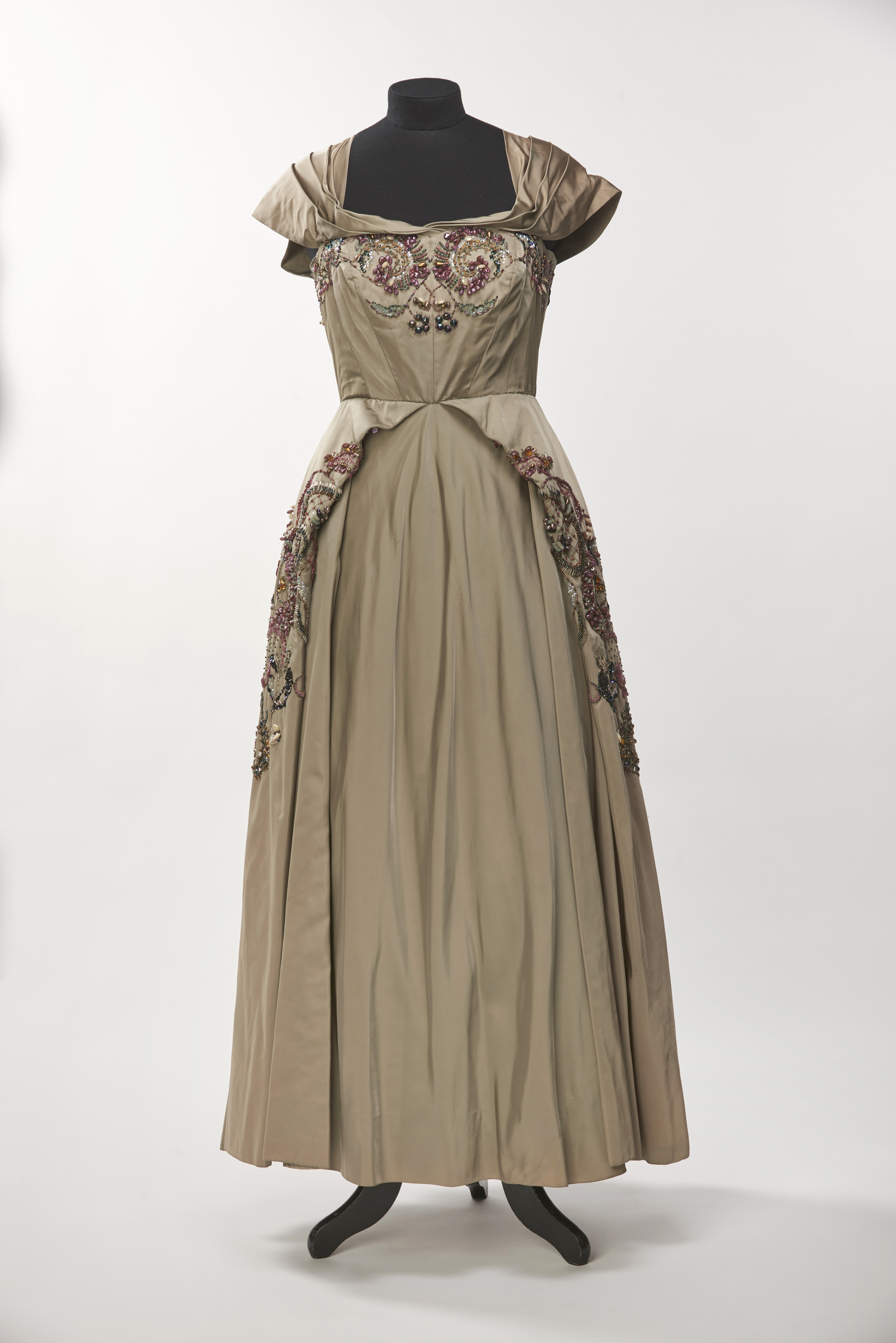
Lucie Whitmore, Fashion Curator at the Museum of London, on a Peggy Lewis dress.
GB Tell me why you chose this.
LW I think this dress has always been really special to me. If pushed, I’d say that it’s my favourite object in our Fashion City exhibition. I thought about objects outside the exhibition too but I’m always pulled back to this. It’s a combination of things: it is the aesthetics and the techniques and the materials, but it’s also beautiful because of the history and what it meant to people. It’s also very special to my career and my progress as a curator. To focus on the look of it, the beading and embroidery on it is very special to me. It’s referencing Jacobean crewel work, stylistically, but it was made in 1950. When you don’t know who makes your clothes, it’s so easy to underestimate them. This embroidery is an amazing “time-smash” of things happening together. I studied textile design so I know enough about embroidery of this period to recognise the motifs and the crosshatching that she’s referencing but it’s also done in a very unique way. I find the evidence of her knowledge very beautiful. But there’s a also a third time period in the time-smash which is evidence of the materials used here. When you look at the beading you see that some are white and some are purple. Those are puffed gelatine sequins and I had never seen those before. Back in 2019 my conservation colleague and I became obsessed with finding out what those were. We were able to identify that they are gelatine beads that were largely produced in Belgium in the 1920s and ‘30s, so I assume Peggy had a pre-war stash. It’s 17th-century design rendered in 1930s materials and made in 1950.
GB Is the gelatine stable?
LW It is as long as it’s stored in the right environment, but it’s very prone to moisture so a few of them have slightly collapsed.
GB When did you first see the dress?
LW I first saw it about two weeks after I’d started working at the the Museum of London. We did an embroidery workshop and I pulled out various pieces from the archive. I was really intrigued by this. The research project for Fashion City started around the same time with my research partner, Bethan Bide, and this was the first object we researched because there was an intriguing suggestion that it was by a maker of Jewish heritage. Once we looked at the object file we discovered the incredible story of Peggy Lewis who made this dress. She was one of six siblings and all of them as well as their father worked in the garment trade in London. They were of Ashkenazy, Eastern-European Jewish heritage. The parents came over from Latvia and settled in Stamford Hill. The father was a wool merchant working in the city. We particularly loved the story of Peggy. Her original name was Nagli and she became Lewis. Her story defies the expected image of Jewish Londoners working in the rag trade. People tend to think of East End sweatshops making menswear but Peggy ran her own business in Fitzrovia making high-end bespoke womenswear.
GB Do you know who she made this dress for?
LW Yes, she made it for her sister, Anne, who wore it to a wedding. We always say she must have stood up to the bride.
GB When was it last worn?
LW It was donated to the museum by Anne’s son in 2002 and since then it’s been boxed away. He donated two ensembles made by Peggy. I then tracked down her grandsons who donated a few additional pieces to our collection, including two unfinished dresses that I really love. The family member all came to the opening event of the exhibition. The pieces are hard to find because they were bespoke and she didn’t seem to label them.
GB Is this dress something you would wear?
LW I find that hard to speak to because as a museum curator I don’t think of wearing pieces in the collection. The way I dress and the way I think about the collection are so separate. I don’t wear a lot of vintage from this period because it’s not my style but if this was my grandmother’s dress and it was in my house I would love to see what it felt like to wear it.
GB Would you expect other people to find it beautiful?
LW I would. From experience, I know that people do. It’s hard to be objective about it having worked with the dress for five years, knowing the whole story. But there’s something about it that’s at once both subtle and a showstopper.
GB I find fashion fascinating beings things can look so beautiful one minute and then they’re out of fashion the next and they look ugly. Once things are a museum piece they become beautiful again. You must see that happening all the time.
LW It is incredibly complicated, the way we think about clothes and how they look. In terms of my work, being a fashion curator in a museum, I see a really interesting thing happen, which is when I acquire for a collection I see an object shift in status, literally from one minute to the next. One minute someone will be holding a piece of clothing from their attic and suddenly it’s not just an old piece of clothing any more. I know that’s quite a strange transition because clothes are so intimate. They take the shape of our body. Often they belonged to a beloved person or lost family member. But once a piece is in our collection it will be looked after in a certain way and at some point brought out and admired. We collect very differently to other museums like the V&A. Our collecting criteria involve judging whether an item tells an important story about London rather than it being famous or aesthetically important. It doesn’t have to be objectively beautiful to have a place in the Museum of London, but we hope to help people find beauty in pieces that aren’t showstoppers. In terms of fashion trends, there has always been an ephemerality to clothes. Throughout history we change our clothes according to taste and style. Other forms of art don’t date in quite the same way. My opinion is that fashion has artistic value but shouldn’t be seen as art because it’s trapped in cycles of capitalism and consumerism and technology. It’s influenced by so many things. And it has to do so much because it’s not just practical but conveys your taste, values and affiliations. Sometimes fashion can be a great work of art and at other times it’s doing something completely different.
GB What makes something worthy of the word Beauty to you?
LW I think, for me, it has to be the marrying of the aesthetic and the story. There’s very little I find beautiful based solely on appearance. My area of expertise is historic dress and to me, the materiality of an object is so important, how the materials are working together. In this instance it’s particularly the beading and embroidery that are making my heart flutter but also the layers of story behind it and its potential to share an important story.
 GILDED BIRDS
Leave a comment